Publications
Article “Digital Citizenship and the Right Not to Use the Internet: The European Approach” by Elżbieta Kużelewska, Mariusz Tomaszuk, Tilen Majnik, Agnieszka Piekutowska, Bruna Žuber
This article examines the European approach to digital citizenship, focusing on the emerging concept of the right not to use the internet. It highlights tensions between policies promoting digital inclusion and respecting individual choice to remain offline. The authors argue that recognising this right is essential to protect personal freedoms and prevent forced digital dependency. The study stresses that inclusive strategies should ensure that non-users can still exercise their civic rights.
Read the publication here: https://bsp.uwb.edu.pl/article/view/1730
New publication: "Towards a Digital Rule of Law: Redefining Citize-State Relations in Digital-Age Democracies"
We are pleased to announce the publication of the article "Towards a Digital Rule of Law: Redefining Citize-State Relations in Digital-Age Democracies" by Arur Olechno, Sabina Grabowska, Hubert Kotarski in the Białostockie Studia Prawnicze (2026) available online via https://bsp.uwb.edu.pl/article/view/1744
This article examines the tension between classical conceptions of the rule of law and the transformation of democratic governance in the digital age. It argues that traditional frameworks are no longer sufficient due to algorithmic opacity, platform power, and automated decision-making. The study combines legal analysis of EU regulations with theoretical and critical approaches to show that digitalisation reshapes the relationship between citizens and the state. It proposes the concept of a “digital rule of law,” supported by digital constitutionalism, stronger safeguards for artificial intelligence, and more inclusive civic participation. The article concludes with recommendations for adapting democratic institutions to contemporary digital challenges.
New Publication: "The Right Not to Use the Internet and Protection against the Digital Divide: Some Preliminary Remarks"
We are pleased to announce the publication of the article “The Right Not to Use the Internet and Protection against the Digital Divide: Some Preliminary Remarks” by Michał Ożóg and Radosław Puchta in the Białostockie Studia Prawnicze (2025) available online via
https://reference-global.com/issue/BSP/30/4 and https://bsp.uwb.edu.pl/issue/view/151.
The article analyses the concept of the “right not to use the internet”
against the backdrop of the digital divide and the ongoing digital transformation. While public policies increasingly promote digitalisation, a significant proportion of society remains excluded from effective access to digital technologies. The authors demonstrate that the digital revolution may undermine freedom of choice by imposing a de facto obligation to be online, and argue that recognising the right not to use the internet can play an important role in combating digital inequalities and protecting individual autonomy.
New Publication: "Human Rights and Digital Choice: Rethinking the Right (Not) to Use the Internet"
We are pleased to announce the publication of the article “Human Rights and Digital Choice: Rethinking the Right (Not) to Use the Internet” by Elżbieta Kużelewska, Damian Malinopwski and Mariusz Tomaszuk in the Białostockie Studia Prawnicze (2025) available online via https://reference-global.com/issue/BSP/30/4 and https://bsp.uwb.edu.pl/issue/view/151.
As digitalisation becomes ubiquitous, the article explores the emerging human rights dimension of the “right not to use the internet.” It argues that genuine digital autonomy requires protecting both access to online spaces and the freedom to remain offline, in order to prevent new forms of exclusion, coercion, and surveillance. Drawing on European human rights standards, the article shows that existing legal frameworks can already safeguard the right to digital non-use.
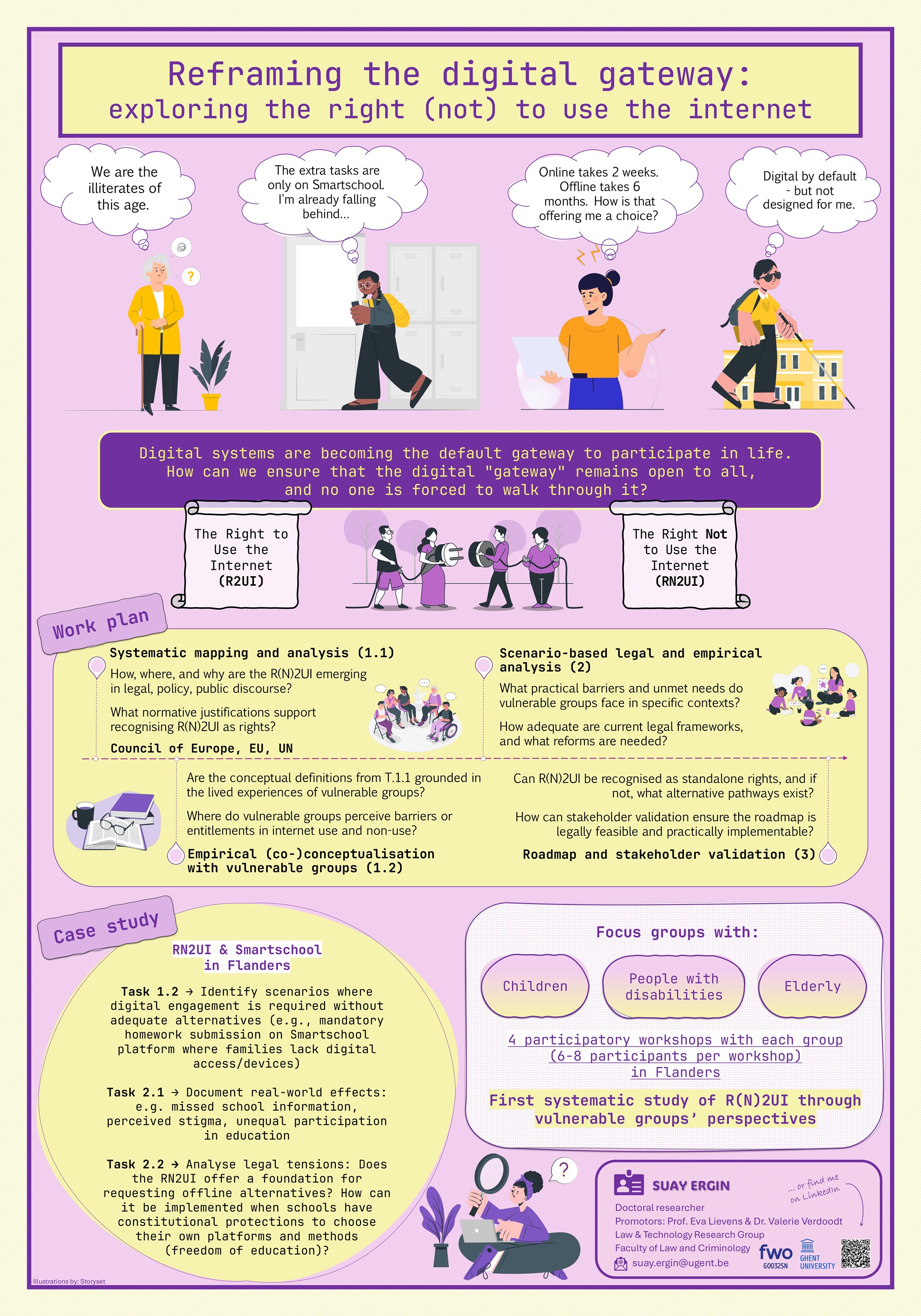
On 14 November, Suay Ergin, a doctoral researcher affiliated with the R(N)2UI - Observatory of the Right (Not) to Use the Internet project from the Law & Technology Research Group of Ghent University, was awarded the First Prize of the Jury for the poster entitled “Reframing the Digital Gateway: Exploring the Right (Not) to Use the Internet” during the Faculty of Law and Criminology Research Day.
The award-winning poster presents Suay Ergin’s doctoral research, which focuses on two emerging fundamental rights situated at the heart of contemporary digital transformation and the gradual disappearance of viable offline modes of participation in social life: the Right to Use the Internet (R2UI) and the Right Not to Use the Internet (RN2UI).
Her research critically examines the consequences of the increasingly “digital-by-default” environment for individuals and communities, particularly those in vulnerable situations. It highlights the legal, social, and practical barriers that arise when access to essential services, education, and civic participation becomes conditional upon digital connectivity and skills. By conceptualising digital access as a gateway rather than an obligation, her work contributes to key European and international debates on digital inclusion, autonomy, and fundamental rights in the digital age.
New publication by Michał Ożóg, PhD
We are pleased to announce the publication of a new article by Michał Ożóg, PhD in the European Journal of Law and Economics (Springer Nature):
Payment by Cash or Card? Restrictions on Cash Circulation in European Union Law in the Perspective of the Right Not To Use the Internet.
The article examines the upcoming EU regulations limiting the use of cash (including a €10,000 cap on cash payments) and introduces a groundbreaking concept: the right not to use the Internet.
Dr. Ożóg argues that restricting cash payments may lead to digital exclusion, especially for people who do not have access to - or do not wish to use - online payment systems.
Read the publication here:
https://link.springer.com/article/10.1007/s11196-025-10374-w
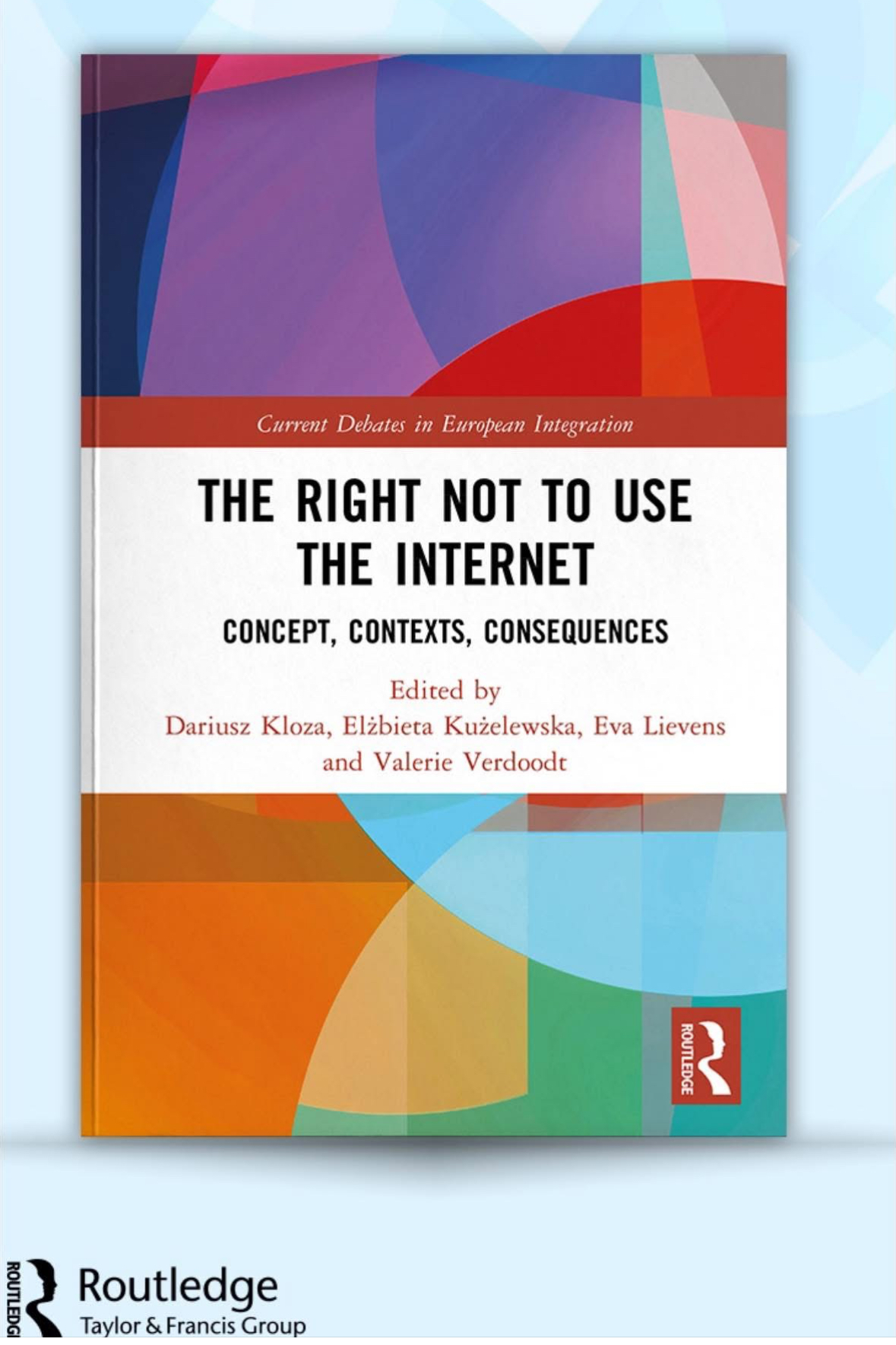
The members of the research project The Right to (Not) Use the Internet: Observatory have published the first academic output of their initiative.
Title: The Right Not to Use the Internet: Concept, Contexts, Consequences
Editors: Dariusz Kloza, Elżbieta Kużelewska, Eva Lievens, and Valerie Verdoodt
This edited volume offers the first comprehensive examination of the emerging human right not to use the Internet, exploring its implications for democracy in an increasingly digital society. As online access becomes essential for exercising rights and fulfilling obligations, the book critically reflects on the legal and philosophical dimensions of opting out.
Contributions from scholars and practitioners across Europe provide timely analysis, policy insights, and proposals for legal reform.
Open Access: Available at www.taylorfrancis.com under a CC BY-NC-ND 4.0 license.
Table of Contents
Introduction
Dariusz Kloza, Elżbieta Kużelewska, Eva Lievens & Valerie Verdoodt
Part 1: The Concept and Its Consequences
- Ethical Meditations for a Human Right to an Analogue Life
Georgios Terzis - An Attempt to Conceptualise the Right to Access the Internet and Its Impact on the Right Not to Use It
Paolo Passaglia - Framing the Right Not to Use the Internet
Mart Susi - Human Rights and the Digital Divide: Recent Developments in the Case Law of the Belgian Council of State
Pauline Lagasse & Sébastien Van Drooghenbroeck - Is There a Right to Be Offline "for No Reason" in France?
Julien Rossi - The Right Not to Use the Internet: Toward a Negative Digital Freedom in Polish Law
Michał Ożóg & Radosław Puchta - Non-Use of the Internet as Human Rights Enabler? The Curious Cases of the Right to Privacy and the Right to Health
Władysław Jóźwicki & Łukasz Szoszkiewicz - Digital Disconnection as a Plight or Right? A Manifesto to Re-imagine Digital Disconnection as a Reasonable Accommodation
Mariek M. P. Vanden Abeele, Marijn Martens, Sarah Anrijs, Sara Van Bruyssel & David de Segovia Vicente
Part 2: Contexts
- Right Not to Use the Internet: Lessons to Be Learned from the Right Not to Be Subject to Automated Decisions
Leonor Moral Soriano - The Meaning of the Limitation of the Use of the Internet for Criminal Punishment from the Perspective of Extended Mind Thesis
Kamil Mamak - Digitalisation of Public Services in Belgium: Enshrining the Right Not to Use the Internet in the Constitution
Elise Degrave - Is the Dematerialisation of Public Services an Elective Progress? A Sociological Analysis of the (Non)Uses by Older People in France
Sabrina Aouici - The Ethics of Choosing Not to Use the Internet: A Comparative Case Study of the Education and Healthcare Sectors in Slovakia and Sweden
Oskar MacGregor & Barbora Badurova - The Right Not to Use the Internet to Play Videogames
Jonathan Keller - An Exploration of the Child's Right Not to Use the Internet: Disentangling from the Digital Web
Eva Lievens & Valerie Verdoodt
New Publication: "The Elderly Digital Divide"
We are pleased to announce the publication of the article “The Elderly Digital Divide: Digital Exclusion Versus the Right not To Use the Internet” by Elżbieta Kużelewska, Michał Tomaszuk, and Dariusz Malinowski in the International Journal for the Semiotics of Law (2025). The article was accepted on 15 July 2025 and officially published on 7 August 2025. It is available online via SpringerLink: https://doi.org/10.1007/s11196-025-10334-4.
The article examines the ways in which older adults engage with or deliberately disengage from the digital environment, conceptualizing this phenomenon within a legal and human rights framework. It critically analyzes the intersection of digital exclusion and individual autonomy, offering nuanced insights into the normative implications of a society that increasingly presumes universal digital participation.